

- Material
-
- Aluminium 61
- Brass 8
- Stainless Steel 8
- Galvanised Steel 1
- Mild Steel 1
What Is the Best Metal to Use for Shelving at Home?
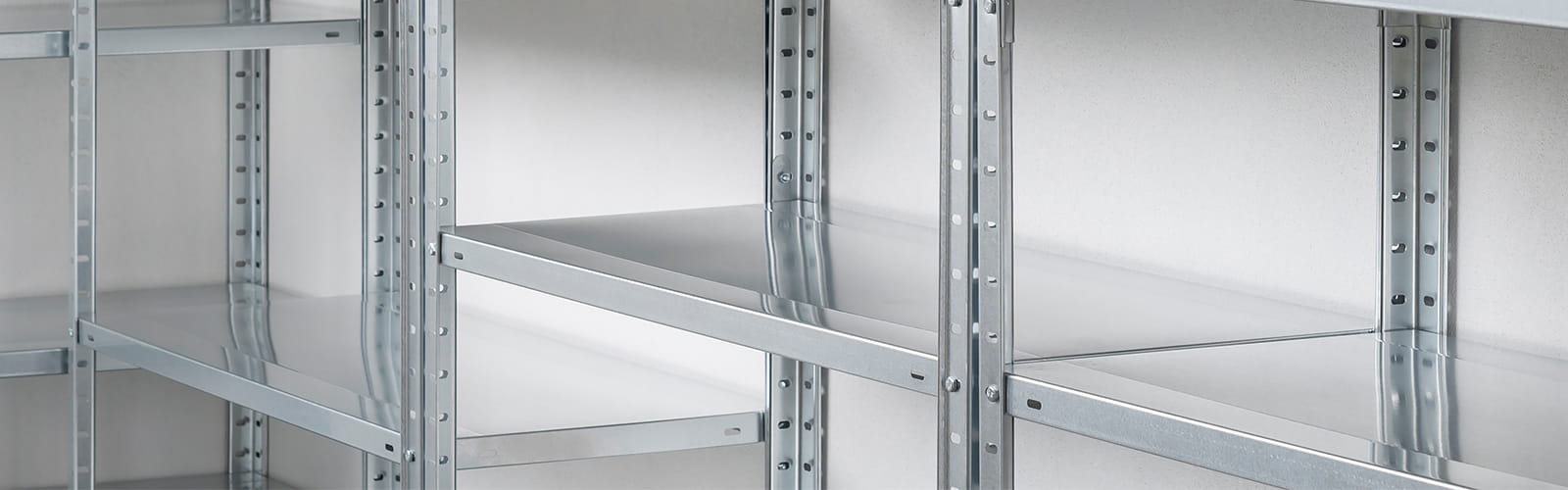
Build shelving from the wrong metal, and you will know about it. A mild steel frame in a damp utility room will start to show rust within months. An aluminium section that looked adequate on paper will deflect under a load that a heavier profile would hold without effort.
Getting the material right at the start saves you from having to redo the shelving project.
The three metals worth considering are:
- Mild steel offers the best load capacity for the price in dry interiors.
- Aluminium resists moisture and suits kitchens, utility rooms, and outdoor spaces.
- Stainless steel is the right choice for wet or hygiene-critical areas.
Here is how to choose the right metal for home shelving, along with the key decisions to make before anything goes on the wall.
Mild Steel Shelving Gives You the Most Load Capacity for Your Budget
Mild steel is the default choice for shelving that needs to carry serious weight. It welds cleanly, cuts predictably, and holds paint without much surface prep, which makes it easy to work with at home. For workshop frames, garage storage, and utility rooms, it is hard to beat for the price.
The two most common structural grades used in the UK are S275 and S355.
SteelConstruction.info, a resource maintained by the Steel Construction Institute and the British Constructional Steelwork Association (BCSA), specifies minimum yield strengths by thickness for sections up to 16mm [1]:
- S275 reaches a minimum yield strength of 275 N/mm², suitable for general shelving frames.
- S355 reaches 355 N/mm², the stronger option for heavier loads or longer spans.
- Strength decreases as thickness increases, so lighter profiles perform as shown in the figures above.
For flat bar brackets or box section frames built from lighter profiles, the load capacity is hard to match at the price.
The trade-off is corrosion. Mild steel will rust if left uncoated or exposed to moisture. For dry interiors, primer and paint are sufficient; for anything near water, powder coating is needed, or a different material entirely. Flat bars, box sections, and angle sections are the three profiles most commonly used for shelving frames and brackets.
Aluminium Is Worth Considering for Kitchen & Utility Shelving
Aluminium will not rust. That single fact makes it a strong candidate for any shelving in a kitchen, utility room, or outdoor storage space where moisture is a regular concern.
The Aluminium Federation's (ALFED) building and construction fact sheet states that aluminium's minimum design service life is 80 years and describes it as virtually maintenance-free. For shelving in damp or humid conditions, durability matters [2].
The main consideration is load relative to section size. The same fact sheet notes that aluminium plate and sheet can be used to build structures at 50-66% of the weight of steel, with equivalent bearing capacity. They are easy to handle and install, but a thicker or wider profile may be needed where a slimmer steel section would otherwise suffice.
Aluminium flat bars, box sections, equal angle, and unequal angle are all worth considering for decorative shelving, lighter storage, or builds where overall weight is a factor.
Stainless Steel Shelving Is the Right Call for Wet & Hygiene-Critical Spaces
Stainless steel is the premium option, and in the right context, the only sensible one. Its corrosion resistance outperforms both mild steel and aluminium in wet environments, and its surface can be cleaned to a food-safe standard with minimal effort.
The British Stainless Steel Association's (BSSA) durability data measures the estimated pit-penetration time, which is the time it takes pitting corrosion to penetrate 1mm of material. In a semi-industrial environment, grade 304 reaches an estimated 135 years to 1mm penetration; grade 316 reaches 525 years. For a kitchen or catering shelf facing daily moisture and cleaning, that performance falls into a different category than anything a painted mild steel frame can offer [3].
The cost is higher, and the material is less forgiving to cut and drill at home. For catering prep areas, wet rooms, or anywhere hygiene is a priority, stainless steel flat bar, box sections, and equal angles are the profiles to consider.
What to Decide Before You Order a Single Cut
Picking the right metal is only the start. Three practical decisions should be made before anything goes on the wall:
- Span and support. The longer the unsupported section, the greater the material's deflection under load. Homebuilding & Renovating (HR) recommends bracket spacing of 500 to 700mm, depending on load and wall structure [4].
- Wall fixing. The shelf is only as strong as what it is bolted to. Masonry walls give the most flexibility; stud walls require fixings into the studs themselves, or specialist plasterboard anchors for lighter loads. Always check for pipes and cables before drilling.
- Finish. Mild steel needs coating to prevent rust. Aluminium and stainless steel are corrosion-resistant in their natural state, though powder coating provides additional protection in harsh environments and enhances appearance on both.
For commercial or heavy-duty applications, our metal processing services page covers guillotine cutting, prefabrication, and finishing options that can take some of the work off your hands.
Why Ordering Metal Cut to Size Makes the Job Easier
Without a cut-to-size supplier, building metal shelving means buying full lengths, cutting on site, and absorbing waste on every order. With a reliable service, you specify exactly what the project needs and what arrives is ready to use. All three materials covered here are available cut to your exact dimensions.
Click Metal has supplied cut-to-size aluminium, mild steel, galvanised steel, and brass to DIY and trade customers since 1994. Every order is cut to -0/+2mm tolerance, covering flat bars, box sections, and angle profiles across all main shelving materials. UK-wide delivery is available, and for larger commercial projects, our parent company, Doré Metals, can step in.
Call 01794 526090 or enquire online to get your shelving metal cut to size and ready to fit.
External Sources
[1] SteelConstruction.info, Steel Material Properties: https://www.steelconstruction.info/Steel_material_properties
[2] Aluminium Federation (ALFED), Aluminium Federation Fact Sheet, Aluminium in Building and Construction: https://alfed.org.uk/wp-content/uploads/2023/10/Aluminium-in-building-and-construction.pdf
[3] British Stainless Steel Association (BSSA), Durability and Life Expectancy for Stainless Steels in External Environments: https://bssa.org.uk/bssa_articles/technical-library-pitting-corrosion-pre-numbers/
[4] Homebuilding & Renovating (HR), Pete Wise, How I Installed a Shelf Securely With Brackets Step-by-Step — Including Pictures: https://www.homebuilding.co.uk/diy/how-to-hang-shelves
Recent Posts


