

- Material
-
- Aluminium 61
- Brass 8
- Stainless Steel 8
- Galvanised Steel 1
- Mild Steel 1
Aluminium vs Steel Flat Bar: Which Should You Choose?
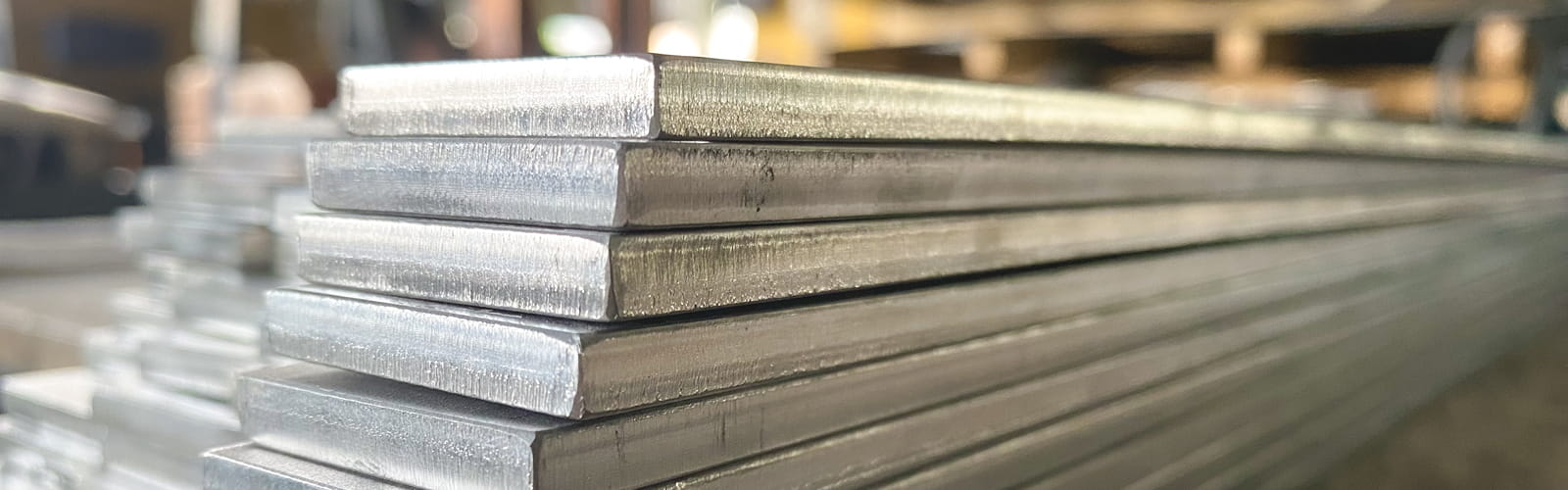
Reach for a flat bar and most people default to steel, because that's what has always been on the bench. It's rarely the right call by default. Aluminium vs steel isn't a contest with one winner; it depends entirely on the job in front of you, and the aluminium flat bar versus stainless steel decision comes down to three things.
This guide works through each one:
- Strength and weight, section for section
- Corrosion resistance, alone and when the two metals meet
- How easy each is to cut, bend, and work with basic tools
By the end, you'll know which one suits your job and how each one plays out.
Strength & Weight
The stainless steel flat bar carries more load for a given cross section than aluminium, but aluminium carries more load for a given weight. Choose stainless steel where the section has to stay small under heavy load. Choose aluminium where every kilogram matters, such as anything you are carrying, lifting, or mounting overhead.
Tensile Strength Compared
Grade makes a real difference here. The British Stainless Steel Association's (BSSA) figures for stainless steel flat sections to BS EN 10088-2 put standard 304 at a minimum 0.2% proof strength of around 210 N/mm² and tensile strength of 520-750 N/mm², while Duplex 2205 reaches 460-480 N/mm² proof strength and 640-950 N/mm², roughly double 304's [1].
Aluminium flat bar sits below these figures across the board, and that gap matters more in practice than it looks on paper. A thinner stainless steel bar, especially in a higher grade like Duplex, can often do a job a thicker aluminium bar cannot.
Weight & Handling
Aluminium's real advantage is what it does not weigh. Cambridge's Dissemination of IT for the Promotion of Materials Science (DoITPoMS) resource explains this through merit indices, strength-to-density ratios used to identify the strongest structure for the least mass. That's why light alloys like aluminium are the default wherever weight matters as much as strength, from aircraft structures down to a workshop shelf bracket [2].
Aluminium's low weight comes straight out of its atomic structure, which is what makes it lighter than almost anything else on the shelf.
Corrosion Resistance & Galvanic Risk
Aluminium and stainless steel both resist corrosion well on their own, through different protective layers. The real risk comes when you bolt or clamp them together. Aluminium sits low on the galvanic series, close to zinc, so it usually ends up as the anode, and in damp conditions the pairing sets up a galvanic cell that corrodes it faster than it would alone.
How Each Metal Resists Corrosion on Its Own
Aluminium forms a thin oxide layer the moment it's cut, and that layer reforms if scratched. Stainless steel relies on a similar passive chromium oxide film, though that film can break down locally, in a crevice for instance, which leaves the steel less resistant than its usual passive state. Both hold up well outdoors without extra finishing, which is one reason so few flat bar projects in either material need painting.
If you want to know what that failure actually looks like before it gets that far, here's what corroded aluminium looks like and how to catch it early.
Why Mixing Them Causes Galvanic Corrosion
The National Physical Laboratory's (NPL) guide to bimetallic corrosion places aluminium near the electronegative end of the galvanic series, well below passive stainless steel. That's why aluminium is almost always the metal that corrodes faster once the two are coupled in wet conditions [3].
NPL notes that fasteners and joints see the worst area ratios in a bimetallic pairing. Under what it calls the catchment area principle, a small aluminium fixing set against a large area of stainless steel corrodes intensely. Use stainless steel fixings with stainless steel bar, and aluminium or isolated fixings with aluminium bar, and the risk mostly disappears.
Ease of Working & Cost
Aluminium is the easier metal to work with basic tools, cutting, drilling, and bending with less effort while blunting blades more slowly than stainless steel. Stainless steel welds cleanly and holds a sharp edge under load, though BSSA's data puts standard 304's machinability at roughly half that of a free-cutting low alloy steel, mostly down to work hardening during machining [4]. For the fuller picture across every profile, take a wider look at aluminium vs steel.
Machinability, Weldability & Bending
Bending aluminium flat bar cold is straightforward within normal radii, and it welds well with the right filler. Stainless steel bends and welds predictably too, but BSSA notes that austenitic grades like 304 and 316 work-harden during any form of cold working, including bending, building up metal at the cutting face and affecting surface finish and tolerance control.
Cost & Available Flat Bar Sizes
Stainless steel generally costs more per kilogram than aluminium, mostly down to the nickel and chromium content that gives it its corrosion resistance. Every order is cut to your exact dimensions, to a -0/+2mm tolerance, and commonly stocked in:
- Thicknesses from a few millimetres up to 40mm for heavier sections.
- Widths suited to shims, brackets, and structural framing alike.
- Lengths cut to your exact dimensions, not a fixed stock size.
Choosing Between Aluminium and Stainless Steel Flat Bar
Get the material wrong, and the cost shows up later, in a section too heavy to lift comfortably or a fixing that's quietly corroding within a year. None of that is inevitable.
Before you order, three things decide it:
- Choose stainless steel where the section must stay compact under load.
- Choose aluminium wherever every kilogram on the job matters.
- Match fixings to the bar to keep galvanic corrosion at bay.
Click Metal cuts both aluminium and stainless steel flat bar to your exact dimensions, so you're not stuck buying a fixed stock length in either material. If you're still weighing one against the other, the team can talk you through the right choice before you order.
Call 01794 526090 or enquire online to get your aluminium or stainless steel flat bar cut to size.
External Sources
[1] British Stainless Steel Association (BSSA), Structural Design of Stainless Steel: https://bssa.org.uk/bssa_articles/structural-design-of-stainless-steel/
[2] Dissemination of IT for the Promotion of Materials Science (DoITPoMS), Strength-Density Selection Map: https://www.doitpoms.ac.uk/tlplib/optimisation-biomaterials/strength_density.php
[3] GOV.UK, National Physical Laboratory (NPL), R. Francis, Guides to Good Practice in Corrosion Control No. 5: Bimetallic Corrosion (2021): https://eprintspublications.npl.co.uk/8617/1/Corrosion%20Guide%20No.5.pdf
[4] British Stainless Steel Association (BSSA), Influence of Steel Family (Type) on Machinability: https://bssa.org.uk/bssa_articles/influence-of-steel-family-type-on-machinability/
Recent Posts


