

- Material
-
- Aluminium 61
- Brass 8
- Stainless Steel 8
- Galvanised Steel 1
- Mild Steel 1
How to Build a Steel Workbench Frame From Scratch
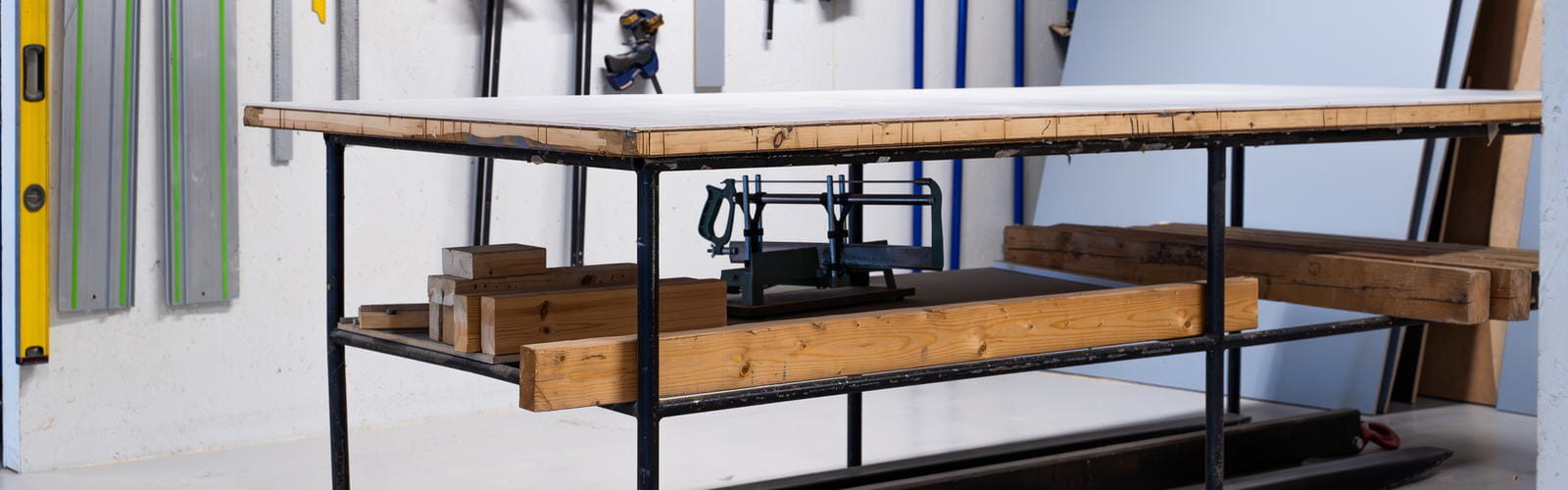
Any strong frame must be the right size, have the right sections, be cut accurately, have secure joints, and a stable top. If all these things are present, you will have a bench that holds its shape under load. If you're planning a workshop build and want to know how to make a steel workbench that suits your space, this guide is for you.
We'll take you through each step, from planning to the finished top, starting with your first decision, which is how big the bench should be.
How Tall and Deep Should a Steel Workbench Be?
Start with the person who will use the bench, because a comfortable working position matters more than any standard measurement. A good workbench height usually falls between 850mm and 950mm, which lets you work without stooping. Standing with your elbows bent at a right angle is a useful check, because your forearms should sit just above the surface.
If you do a lot of heavy hammering, opt for a slightly lower surface, while a slightly raised surface is better suited to detailed tasks.
And you should give the same degree of thought to workbench depth. A depth between 600mm and 750mm gives you enough room to clamp a workpiece and still reach the back edge, without making your steel workbench too wide to work across, which is a common mistake in a first build. Once you have settled length, height and depth, you can draw up a cutting list for the workbench frame, which shows exactly which steel sections you need to look at next.
Which Steel Sections Make the Best Workbench Frame?
If you are wondering how to make a steel workbench that stays rigid, the answer starts with choosing the right sections for each job in the frame. Most home builds use three, and each has a clear role in general fabrication:
- Box Section: Square or rectangular hollow tube, such as 40mm x 40mm with 2mm to 3mm walls, which is ideal for legs and rails because it resists bending in every direction.
- Square Bar: Solid steel bar that adds weight and strength where you need it, so it suits shelf supports and lighter bracing.
- Flat Bar: A thin, wide strip that works well for gussets, corner brackets and fixing plates, which stiffen joints without adding bulk.
Once you know which sections you need, the next job is turning them into an accurate frame through careful cutting and the right joining method.
Cutting, Grinding and Joining Your Frame
Work from your cutting list and mark each length clearly before you cut, because an error of a few millimetres on one leg will rock the whole bench. Grinding comes next, and it matters because removing mill scale, the dark oxide layer on new steel, along with any rust from the joint areas gives you a sound connection, while smoothing sharp edges makes the finished frame safer to handle.
For joining, you have two sensible routes. MIG welding creates a rigid, permanent frame, although it needs a welder and good ventilation. A bolted frame needs only a drill and spanners, which makes it a good fit for a first build, and it can be taken apart if you move. Whichever you choose, check each corner with a square before fixing it, so the frame stays true, and then you can choose the surface you will work on.
Steel Top or MDF Top: Choosing a Stable Work Surface
Anyone learning how to make a steel workbench has to decide what the top will be made from, because it affects the weight of the bench and the way you use it. A steel top, usually a plate of 3mm to 6mm, is tough and resists heat and sparks, which makes it ideal for welding and hot work. The trade-off is weight, noise and a surface that can mark delicate workpieces, so the frame beneath must be strong enough to carry it.
An MDF top is lighter, quieter and kinder to materials, and it is easy to replace when it wears. Bear in mind that it isn't suited to welding or hot work, so it works best for assembly, marking out and workshop tasks. Whichever option you pick, fix it to the frame with a small overhang, which leaves room for clamps.
Getting Your Workbench Steel Cut to Size with Click Metal
Knowing how to make a steel workbench is only half the job, because the frame is only as accurate as the steel you start with. At Click Metal, our box section, square bar and flat bar are all cut to size, so every length arrives ready for your cutting list with no extra trimming. Here is what that means for your build:
- General cutting tolerance of + or - 2mm
- No minimum order charge
- Most orders processed and despatched within 48 hours
- Nationwide courier delivery
We supply direct to the public and to businesses, so one length is as easy to order as a full set. If you cannot find the exact size in the shop, get in touch and we will do our best to help. For larger or commercial requirements, our parent company, Doré Metal Services, is on hand to support you.
Order Your Workbench Steel and Start Building
A dependable bench comes down to careful planning, ensuring a comfortable height and depth, the right sections, accurate cuts, a square frame and a top that suits your work. You can order your steel online today or call our team on 01794 526090 if you would like advice first.
If your size is not in the shop, send your requirements through our contact form, and we'll ensure you get your steel order right.
Recent Posts


